

A senior buyer at a national jewellery brand told us, after a Diwali campaign that under-delivered in Jaipur despite over-delivering in Mumbai with identical artwork, that they had assumed Jaipur was a smaller version of Delhi. The campaign manager had used the same Delhi rate card, the same English-led artwork, and the same generic Hindi-belt media plan. Three things went wrong. The artwork failed JMC Heritage pre-screening for the walled-city pincodes. The Hindi-language version under-weighted the Rajasthani cultural cues that drive jewellery purchasing in this city. And the campaign missed the wedding-season window that drives 56 percent of annual retail spending in Jaipur. The Delhi playbook does not translate. Jaipur runs on its own rules.
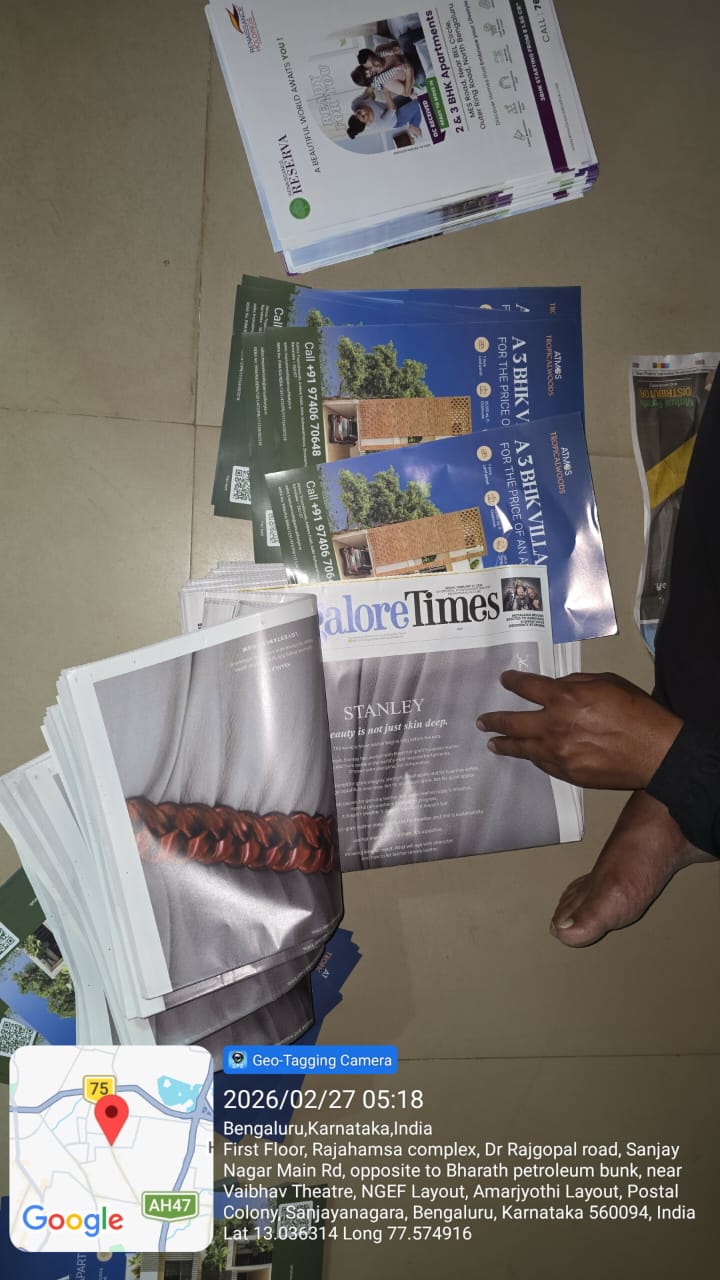
Newspaper insertion in Jaipur operates on three rules that distinguish it from the Delhi or Mumbai playbook. A Hindi-daily duopoly that prices without vernacular discount. A two-municipal-corporation split (JMC Heritage and JMC Greater) with distinct artwork regulations inside the walled city. And a wedding-season demand cycle that concentrates 56 percent of annual newspaper insertion revenue into a 5-month window from October to February. This guide unpacks every rule, rate, and regulatory boundary for 2026.
Jaipur's two-daily duopoly
Five dailies carry roughly 96 percent of Jaipur's newspaper readership. Two Hindi dailies dominate by absolute reach. Dainik Bhaskar Jaipur (Hindi, morning) at 17.4 lakh average issue readership per IRS Q1 2026 data. Rajasthan Patrika (Hindi, morning) at 14.6 lakh. The two together reach roughly 32 lakh readers daily, with very high cross-readership overlap because most Jaipur households read both. Dainik Navjyoti (Hindi, regional) at 4.8 lakh skews older and outer-suburb. The three Hindi dailies together cover roughly 92 percent of the Jaipur readership universe.
Two English dailies serve a narrow corporate segment. Times of India Jaipur at 3.2 lakh covers government officials, tourism corporates, and the IT corridor in Malviya Nagar and Jagatpura. Hindustan Times Jaipur at 1.4 lakh skews younger professional. The two English dailies together reach roughly 4.6 lakh readers, less than a third of Dainik Bhaskar alone.
Operational implication: any Jaipur campaign that goes English-only undershoots reach by 85 percent. The Hindi duopoly is so dominant that single-Hindi-daily campaigns (Dainik Bhaskar only or Rajasthan Patrika only) capture roughly 65 percent of relevant reach because the same household subscribes to both papers but reads them at different times of day. The right mix is almost always both Hindi dailies plus optional English supplementation for the IT corridor specifically.
How are Jaipur insertion rates zoned across the city?
Zone A: MI Road-C-Scheme-Civil Lines premium (pincodes 302001, 302006, 302014)
MI Road (302001), C-Scheme (302001), Civil Lines (302006), Bani Park (302016), the new commercial belt around World Trade Park. Per-piece rates run 18 to 22 percent above the city average. ₹1.40 for A5, ₹1.75 for A4, ₹2.22 for A2 on standard paper. The premium reflects Jaipur HNI density (royal family connections, established Rajasthan business families, government officials, tourism corporates), and the corridor's role as the city's primary commercial showcase visible to both tourists and residents. For luxury jewellery, premium retail, fine dining, finance, and tourism-adjacent commerce, this zone delivers 3 to 4 times the response per rupee of mass-market alternatives.
Zone B: Vaishali Nagar-Mansarovar mid-premium (pincodes 302021, 302020, 302017)
Vaishali Nagar (302021), Mansarovar (302020), Malviya Nagar (302017), Jagatpura, the western and southern professional residential belts. Per-piece rates track the city average within 3 to 5 percent. ₹1.18 for A5, ₹1.48 for A4, ₹1.85 for A2. These zones serve the modern Jaipur middle class: professionals, entrepreneurs, IT workers, and the family households that drive most non-luxury retail spending. For mid-market retail, real estate, school admissions, household appliances, and family-decision categories, this is the right primary target. Malviya Nagar and Jagatpura specifically over-index on English daily consumption versus the Jaipur average because of the IT corridor workforce composition.
Zone C: Walled City heritage and outer suburbs (pincodes 302002, 302003, 302005, 302019, 302023)
Walled-city pincodes 302002 and 302003 sit inside the JMC Heritage zone. Outer suburbs Tonk Road, Sirsi Road, Jhotwara, Sanganer cover the lower-income and outer-Jaipur households. Per-piece rates run 7 to 12 percent below the city average in outer suburbs at ₹1.08 for A5, ₹1.35 for A4. The walled city pincodes carry the same base rate but add a JMC Heritage pre-screening surcharge of ₹0.18 to ₹0.28 per piece because every artwork requires zonal-officer review. For mass-market FMCG, school admissions, and household goods, the outer suburbs are the cheapest CPM. For artwork that genuinely fits the heritage aesthetic (Rajasthani cultural cues, jewellery, traditional weddings, religious calendars), the walled city carries premium HNI reach even at the surcharge.
Jaipur's three insertion rate zones (2026)
| A5 rate | A4 rate | Best for | |
|---|---|---|---|
| Zone A: MI Road-C-Scheme-Civil Lines | ₹1.40 | ₹1.75 | Luxury jewellery, premium retail, fine dining, finance |
| Zone B: Vaishali Nagar-Mansarovar-Malviya Nagar | ₹1.18 | ₹1.48 | Mid-market retail, real estate, school admissions, appliances |
| Zone C: Outer suburbs (Tonk Road, Jhotwara, Sanganer) | ₹1.08 | ₹1.35 | Mass-market FMCG, school admissions, household goods |
Walled-city pincodes 302002/03 carry base rates plus a JMC Heritage pre-screening surcharge of ₹0.18-0.28 per piece.
The MI-Road-to-Mansarovar arc, pincode by pincode
The corridor from MI Road through C-Scheme to Bani Park, Vaishali Nagar, and Mansarovar carries roughly 60 percent of all Jaipur newspaper insertion volume. The Mediaverse 2026 rate map: MI Road (302001): ₹1.42 A5, ₹1.78 A4. C-Scheme (302001): ₹1.40 A5, ₹1.75 A4. Civil Lines (302006): ₹1.38 A5, ₹1.72 A4. Bani Park (302016): ₹1.32 A5, ₹1.65 A4. Vaishali Nagar (302021): ₹1.22 A5, ₹1.52 A4. Mansarovar (302020): ₹1.18 A5, ₹1.48 A4. Malviya Nagar (302017): ₹1.20 A5, ₹1.50 A4. Jagatpura (302017): ₹1.18 A5, ₹1.48 A4. The arc shows a 20 percent rate spread between MI Road (premium) and Mansarovar (mid-suburb) across roughly 10 kilometres, sharper than the Lucknow or Patna gradient but gentler than Ahmedabad.
Operationally, the arc has one quirk worth knowing. The 302017 Malviya Nagar pincode spans two distinct distribution sub-routes: Malviya Nagar proper (English-leaning IT corridor) and Jagatpura (mid-income residential Hindi-leaning). A brief that says 302017 without specifying which sub-area receives a blended distribution that may underweight either targeting. Specify the sub-area on every Malviya-Jagatpura brief.
JMC Heritage and JMC Greater: the two-corporation regulatory reality
Jaipur is the only major Indian metro with two distinct municipal corporations governing one urban area. The 2019 reorganisation split the historic Jaipur Municipal Corporation into JMC Heritage (covering the walled city plus Civil Lines and Bani Park) and JMC Greater (covering Vaishali, Mansarovar, Malviya Nagar, Jagatpura, and all outer suburbs). The split was administratively driven but it has direct consequences for newspaper insertion artwork.
JMC Heritage enforces three artwork rules inside the walled city pincodes 302002 and 302003. First, logo size cannot exceed 30 percent of the total artwork surface area, intended to keep modern brand assets from visually competing with Pink City facade visibility. Second, neon, fluorescent, and high-saturation colour palettes are restricted. Earth tones, terracotta, and the heritage pink palette are permitted at any saturation level. Third, English-language-only artwork is restricted: Hindi must appear at equal or larger weight in any insert distributed inside the walled city. JMC Greater operates under standard municipal advertising regulations with no special artwork requirements beyond the national ASCI guidelines.
The pre-screening process for JMC Heritage takes 3 to 5 working days for first-time advertisers and 1 to 2 days for repeat. The artwork submission requires the artwork in PDF format plus a one-page Hindi-language summary of the offer. Vendors that work the Jaipur market well handle this submission on the advertiser's behalf. Vendors that do not push back on the Heritage zone rules usually result in pulled-after-print incidents that cost the brand 100 percent of the campaign value.
The Hindi-language vendor ecosystem
Jaipur newspaper insertion runs through three vendor types. The newspaper agencies themselves handle direct booking. DB Corp handles Dainik Bhaskar Jaipur and Bhaskar Rasrang Sunday supplement. Rajasthan Patrika group handles Rajasthan Patrika. Times Internet handles TOI Jaipur. These direct channels offer the best per-daily rate if you need only one paper but rarely bundle multi-daily campaigns.
The Jaipur metro insertion specialists are the second category. They bundle Dainik Bhaskar plus Rajasthan Patrika plus optional English campaigns, handle JMC Heritage and JMC Greater artwork pre-screening, and provide Hindi translation rigor for non-Rajasthani brands. The Mediaverse falls into this category. Multi-daily campaigns above ₹50,000 typically save 8 to 14 percent through specialist booking, and the heritage-zone pre-screening rigor avoids the artwork-rejection patterns that out-of-state brands run into.
The third vendor type is the printer-distributor combine, often a Sanganer or Vidyadhar Nagar industrial-area facility. They quote the cheapest per-piece rate but rarely offer JMC Heritage pre-screening or Hindi translation rigor. For first-time Jaipur advertisers, the heritage-zone language and regulatory specificity makes the metro specialist worth the marginal premium.
The wedding-and-tourism economic cycle
Jaipur runs on an October-to-February economic cycle that concentrates 56 percent of annual newspaper insertion revenue. Three forces converge in this window. The wedding season (October Karwa Chauth through February-end) drives retail, jewellery, clothing, catering, event-venue, and travel spending. The tourist season (cooler weather, lower haze, comfortable temperatures) brings extended-stay visitors who often subscribe to local newspapers for tourist supplements. And the post-monsoon retail-replenishment cycle compresses 4 months of normal-month consumer spending into the festival weeks.
Newspaper insertion rates climb 18 to 28 percent during this window. The Mediaverse field data across 22 wedding-season campaigns shows redemption rates climb 2.6 to 3.8 times over non-wedding windows for retail, jewellery, clothing, and event-services categories. The premium pays for itself for any brand with a wedding-related offer. Non-wedding categories (B2B, automotive, finance, industrial) should time campaigns to August (pre-wedding) or March-April (post-wedding) for cleaner economics. The summer May-July window is the cheapest CPM but also the lowest commercial-intent period because heat-driven outflow of residents to hill stations creates a temporary readership trough.
A 2026 Jaipur campaign launch playbook
Walk through a real campaign brief. A premium wedding-jewellery brand launching a flagship store on MI Road for the November-December wedding peak. ₹6 lakh all-in budget. Target audience: 28 to 55 year old families across MI Road, C-Scheme, Bani Park, Civil Lines, and the upper-middle-class Vaishali Nagar. Goal: store walk-ins in the wedding fortnight, with a secondary KPI of consultation appointments booked.
Step 1, working budget. ₹6,00,000 minus 18 percent GST = ₹5,08,475 ex-GST. Reserve ₹35,000 for design and Hindi-English bilingual artwork plus JMC Heritage pre-screening. Reserve ₹55,000 for printing setup and proof-of-distribution. Working budget for media: ₹4,18,475.
Step 2, edition mix. Target audience reads Dainik Bhaskar Jaipur and Rajasthan Patrika at near-equal rates across the wedding-buying segment. TOI Jaipur adds incremental English-reading HNI plus tourist-corporate reach. Mix: Dainik Bhaskar 45 percent, Rajasthan Patrika 35 percent, TOI Jaipur 20 percent.
Step 3, pincode targeting. MI Road (302001), C-Scheme (302001), Civil Lines (302006), Bani Park (302016), Vaishali Nagar (302021). Five pincodes, total target households roughly 1.8 lakh. Avoid the walled-city pincodes 302002/03 unless the artwork has been adapted to JMC Heritage rules.
Step 4, campaign cadence. Two waves: launch Sunday Dainik Bhaskar with the Rasrang supplement (wedding-targeted, highest engagement for jewellery category), then a Saturday Rajasthan Patrika plus Sunday TOI combo for second-impression frequency in week two. A4 size, 130 GSM premium paper (jewellery category justifies the premium feel), Hindi-primary with English secondary, double-sided, no fold.
Step 5, volume math. ₹1,88,313 for Sunday Dainik Bhaskar Rasrang across MI-Road-to-Vaishali pincodes at ₹1.95 average per piece (Sunday wedding-season surcharge included): roughly 96,500 pieces. ₹1,46,466 for Saturday Rajasthan Patrika at ₹1.85 per piece: roughly 79,200 pieces. ₹83,696 for Sunday TOI at ₹2.05 per piece: roughly 40,800 pieces. Total: 216,500 pieces across two weeks. With 2.6 readers-per-copy in Hindi daily readership and 2.8 in English daily readership, total reader exposure ~5.7 lakh impressions including frequency overlap.
Step 6, attribution. Print a unique missed-call number on the flyer, a unique discount code valid only on launch fortnight redemptions, and a wedding-consultation booking link via QR code routing to a Hindi landing page. Hindi QR-scan rate for wedding-jewellery in Jaipur runs roughly 2.6 times the English QR-scan rate, so the separate tracking confirms the Hindi-primary positioning is working.
Bottom line for a 2026 Jaipur campaign
Pick your zone first (MI-Road premium, Vaishali-Mansarovar mid-market, walled-city heritage, or outer-suburb mass-market). Pick your edition mix second, weighted Dainik Bhaskar plus Rajasthan Patrika for almost every category. Pick your pincodes third, splitting 302017 into its Malviya-Nagar versus Jagatpura sub-areas where it matters. Time campaigns to wedding season for category-relevant offers, away for everything else. Pre-screen artwork for JMC Heritage rules if any walled-city pincodes are in scope. With these five disciplines your Jaipur campaign will outperform the same budget spent on any single digital channel for retail, wedding, jewellery, and tourism-adjacent objectives by 2 to 4 times on landed cost-per-walk-in.
Can I run a single-Hindi-daily campaign in Jaipur or do I need both Dainik Bhaskar and Rajasthan Patrika?
Both. Jaipur's two-daily duopoly has roughly 30 to 35 percent unique-reader households between Dainik Bhaskar Jaipur and Rajasthan Patrika, meaning a single-daily campaign captures roughly 65 percent of relevant Hindi-reading households. The remaining 35 percent are reachable only through the other daily. For any campaign above ₹50,000, both dailies are the correct media plan. Below ₹50,000, pick the daily that matches your target demographic: Dainik Bhaskar skews slightly newer-Jaipur (Vaishali, Mansarovar, Malviya Nagar); Rajasthan Patrika skews slightly older-Jaipur (MI Road, Civil Lines, Walled City).
Does newspaper insertion work for Jaipur's tourism-adjacent retail brands?
Yes, but with a different media plan than resident-targeting campaigns. Tourism-adjacent brands (handicrafts, jewellery showrooms, premium textile stores, heritage hotels) should book TOI Jaipur and Hindustan Times Jaipur for the English-reading domestic tourist segment, plus Dainik Bhaskar Sunday Rasrang for the wedding-shopping resident segment that overlaps strongly with tourism wallet. Skip Rajasthan Patrika for pure tourism-targeting because its readership skews older-resident with lower discretionary tourism-adjacent spend.
What is the smallest Jaipur newspaper insertion campaign that still has good economics?
3,500 pieces in a single pincode through Dainik Bhaskar weekday edition is the practical floor for Jaipur, lower than the metro average because Jaipur has the lowest household-density-to-rate ratio of any tier-1 metro. Below 3,500, per-piece rates climb above ₹1.95 and you are better served by auto rickshaw branding in the same pincode at ₹180 per auto per month. For wedding-season pilots between 3,500 and 10,000 pieces, the JMC Greater pincodes deliver the best CPM at ₹1.45 to ₹1.65 per piece all-inclusive.
Looking for professional Newspaper Insertion services?
The Mediaverse runs end-to-end newspaper insertion campaigns across India with geo-tagged delivery and transparent, all-inclusive pricing.
Explore our Newspaper Insertion solutionsSummarize this guide with AI
Open this article in your favourite AI assistant
Related Guides
Written by

The Mediaverse Team
India's Leading Outdoor Advertising Agency
The Mediaverse is a national-level outdoor advertising and integrated marketing organization that provides complete OOH, ATL, BTL, retail, and transit media solutions across India. With years of experience executing high-performance campaigns for brands in FMCG, Real Estate, E-commerce, EdTech, Automotive, Healthcare, and Retail, The Mediaverse combines creativity, data-driven media planning, and flawless on-ground execution. As a full-stack outdoor advertising provider, The Mediaverse offers Auto Branding, Mobile Van Branding, Newspaper Insertion Advertising, Shop Name Board Branding, In-Store Branding, Hoardings, Transit Media, Kiosks, Mall Media, Activations, and all forms of Below-The-Line marketing. Known for its pan-India network, strategic route planning, premium print quality, and Cheqmate™ GPS-based verification, The Mediaverse ensures 100% transparent and result-oriented campaign delivery. The Mediaverse’s editorial team produces deeply researched, SEO-optimized, and generative-engine-friendly content to help businesses understand the power of outdoor advertising and make informed decisions that maximize brand visibility and ROI across urban, suburban, and rural markets.
Related Articles
How to plan a newspaper insertion campaign in India: the 2026 step-by-step guide
What does newspaper insertion cost, how precise is the targeting, and how do you run a campaign? The complete 2026 guide to newspaper insertion in India, from pincode targeting to measurement.
Print inserts or digital ads for a local business: the 2026 budget-split decision guide
Is newspaper insertion still worth it against digital ads in 2026? A decision guide with a spec table, when each wins, how to combine them, and a checklist for local businesses.
Pincode targeting for newspaper insertion across India: the 2026 multi-city playbook
How do you put your flyer into just the right neighbourhoods? A 2026 playbook for pincode-targeted newspaper insertion: costs, a targeting-levels table, a 7-step method, and how to measure response.