
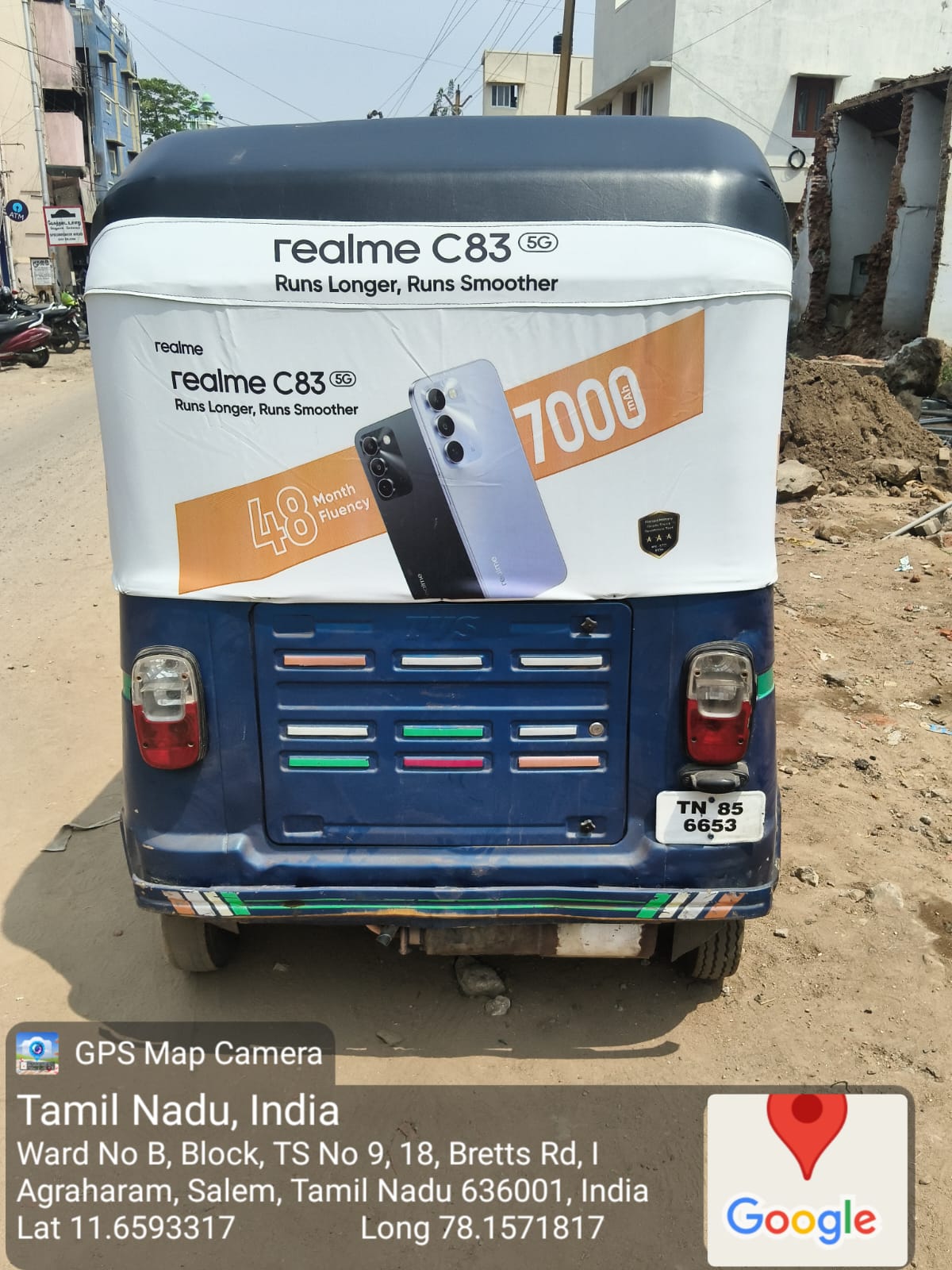
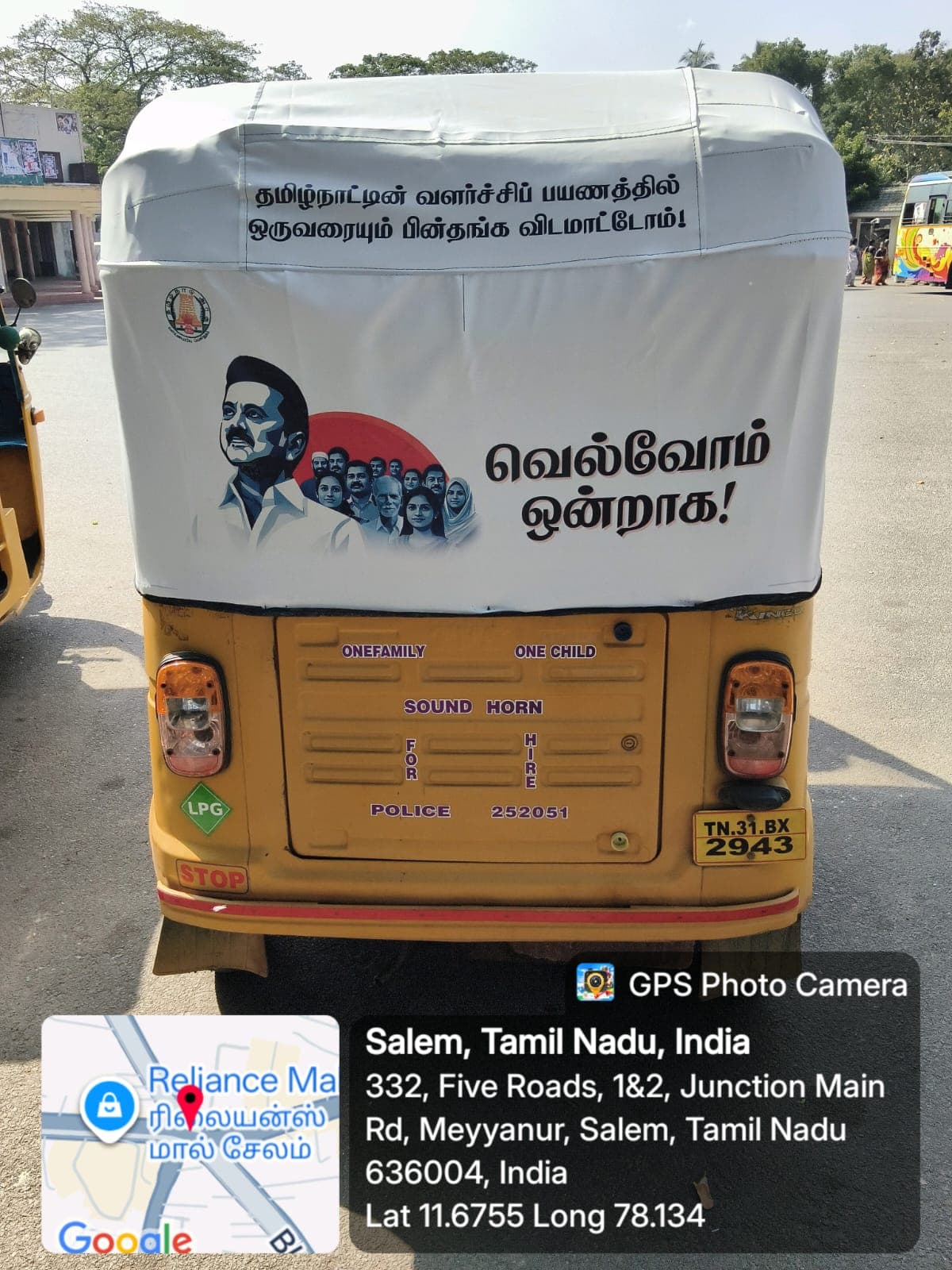
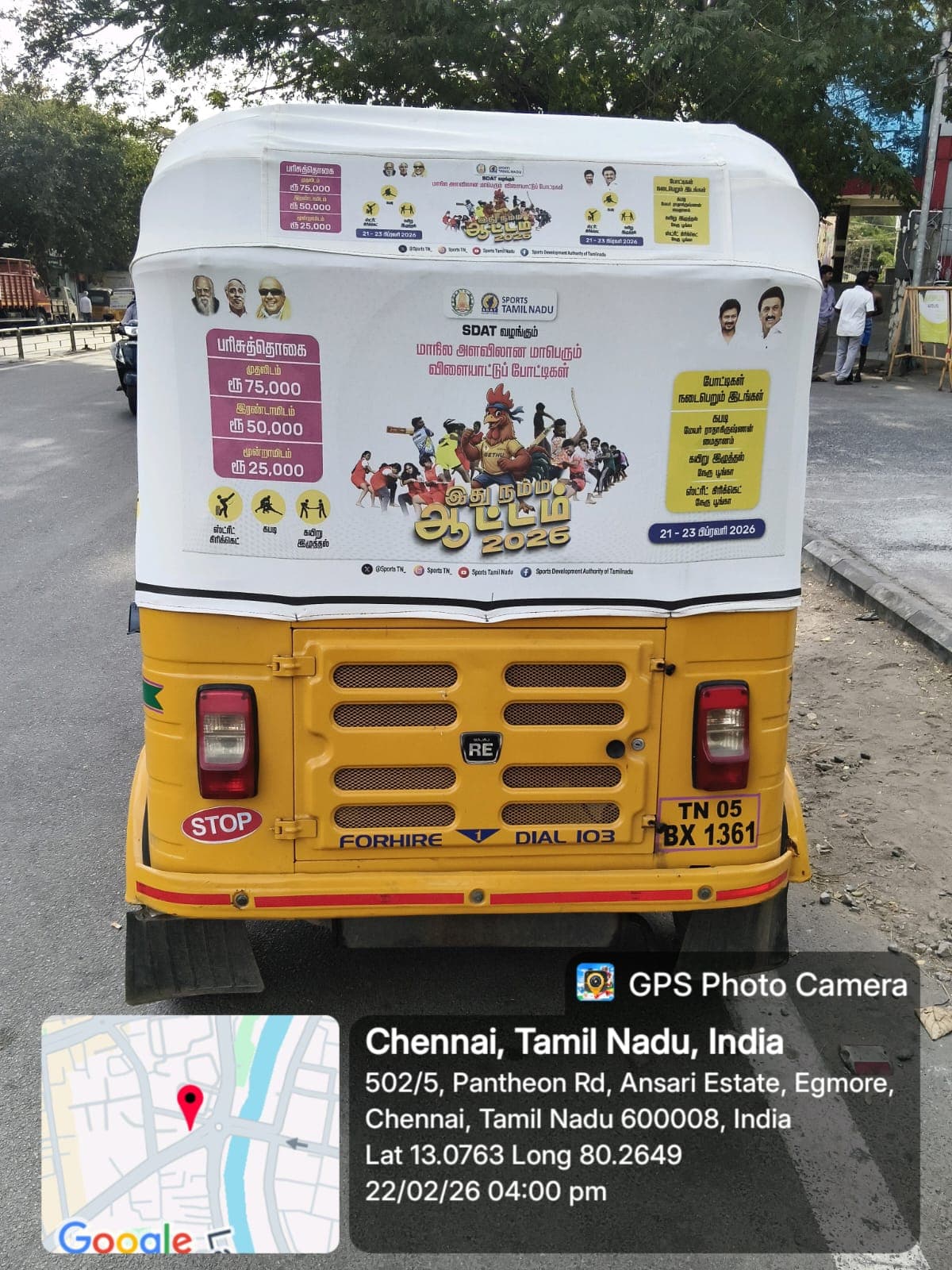
When we plan an auto campaign for a Jaipur jeweller before the wedding season, we are solving a problem most cities never pose: the fleet has to work for two completely different audiences at the same time. One is the local Jaipur buyer in Vaishali Nagar or Malviya Nagar. The other is the tourist threading through the walled Pink City, where hoardings are restricted and a branded auto is one of the only legal ways to carry a message into Johari Bazaar. Get that duality right and Jaipur rewards you; ignore it and you have paid metro money for half a campaign. Here is what auto branding in Jaipur actually costs in 2026, where the fleet works, how the heritage rules constrain you, and why the November-to-February wedding season changes the entire calculation. Full hood branding runs ₹550 to ₹650 per auto per month, back-panel stickers ₹150 to ₹180, and a full wrap ₹2,000 to ₹2,400, all inclusive of design, printing, installation, and maintenance.
Auto branding in Jaipur at a glance: the numbers and the constraints
Seven anchors define a Jaipur auto plan in 2026. Fleet size: an estimated 50,000 registered auto-rickshaws across the JMC area. Hood branding rate: ₹550 to ₹650 per auto per month, with local campaigns often nearer ₹550. Back-panel rate: ₹150 to ₹180. Full-wrap rate: ₹2,000 to ₹2,400. Daily impressions per auto: an estimated 22,000 to 32,000. Cost-per-thousand impressions: roughly ₹3 to ₹7, among the most efficient of any Indian city. Recommended minimum for one catchment: 25 to 30 autos for 30 days. Two non-numeric constraints sit above all of these: the walled-city heritage restrictions, and the wedding-season demand surge.
The Pink City rule: heritage limits inside the walled city
Jaipur's walled city, the original Pink City, is a protected heritage zone, and the Jaipur Municipal Corporation restricts outdoor advertising and fixed signage inside it to preserve the historic pink facades and the UNESCO-listed streetscape. For an advertiser, this is a hard constraint: you cannot put up hoardings, gantries, or permanent media inside the walled bazaars of Johari Bazaar, Bapu Bazaar, and Tripolia Bazaar, which happen to carry some of the densest tourist and shopping footfall in the city. This is exactly where branded autos earn their keep. Because the autos move and carry no permanent fixed signage, a branded fleet plying the heritage bazaars is one of the few compliant ways to get a brand message into the Pink City core.
The practical play is to run a portion of your fleet on the walled-city approaches and the bazaar circuits, especially if you sell jewellery, handicrafts, textiles, or anything tourist-facing, while keeping the bulk of the campaign on the modern commercial and residential belts where most local buying happens. Confirm with your vendor that the autos and their routes comply with JMC heritage norms, and keep creative clean and uncluttered; gaudy artwork reads badly against the heritage backdrop and can attract enforcement attention.
Jaipur's auto fleet and how far it reaches
With an estimated 50,000 registered autos, Jaipur has strong fleet availability for a city its size, and the autos genuinely cover the whole urban geography, from the heritage bazaars in the old city to the newer western suburbs of Vaishali Nagar and Mansarovar and the southern industrial belt at Sitapura. Jaipur traffic is moderate by metro standards, neither gridlocked like Mumbai nor free-flowing, which keeps per-auto dwell time healthy without the extreme congestion premium. The result is an estimated 22,000 to 32,000 daily impressions per branded auto and a cost-per-thousand of roughly ₹3 to ₹7, making Jaipur one of the most cost-efficient auto-branding markets in the country.
The Jaipur zone map: spine, residential west, tourist core, and industry
Jaipur splits cleanly into four advertising catchments. Pick the one that matches your business and saturate it rather than ringing the whole city.
The commercial spine: MI Road, C-Scheme, Tonk Road
MI Road is Jaipur's primary commercial artery, with C-Scheme as its office and premium-retail extension and Tonk Road running south through dense mid-market commerce. This spine carries the highest combined retail-and-office footfall in the city and suits banking, retail, hospitality, education, and brand-led campaigns. It is the default first catchment for most Jaipur advertisers and where you should anchor a hood-led fleet.
The residential west and south: Vaishali Nagar, Mansarovar, Malviya Nagar
Vaishali Nagar and Mansarovar to the west and Malviya Nagar to the south are Jaipur's large, settled residential catchments, full of families, schools, clinics, and neighbourhood retail. These belts are where local household buying decisions are made, so they suit FMCG, healthcare, education, home services, and value retail. Rates here sit at the lower end of the band, and frequency within a single colony cluster drives strong recall.
The tourist core and walled-city approaches
The approaches to the walled city and the bazaar circuits around Hawa Mahal, Johari Bazaar, and Bapu Bazaar carry a dual audience of locals and tourists. This is the catchment for jewellery, gemstones, handicrafts, ethnic apparel, and hospitality brands that want both the resident buyer and the visitor. Because fixed signage is restricted here, branded autos do disproportionate work, and a small dedicated sub-fleet on these routes can outperform far more expensive media elsewhere.
Industrial and IT: Sitapura and Sanganer
The Sitapura industrial area and the Sanganer belt to the south anchor Jaipur's manufacturing, gems-processing, and IT-SEZ workforce. For B2B suppliers, workforce-facing services, skilling institutes, and brands targeting the industrial corridor, a focused fleet here reaches a defined, repeatable commuter audience that the commercial spine does not cover as efficiently.
Hood, back-panel, or full wrap for a Jaipur campaign
Hood branding is the workhorse for Jaipur: it sits at eye level for the two-wheeler riders and pedestrians who dominate the city's roads and bazaars, and it photographs well against Jaipur's distinctive streetscape, which matters for tourist-facing brands. Back-panel stickers at ₹150 to ₹180 are the budget entry point for awareness and offer-led messaging. Full wraps at ₹2,000 to ₹2,400 are best kept to a small hero fleet for a launch or for the tourist-core routes, where a striking wrap doubles as content tourists photograph. For a typical Jaipur campaign, run a hood-led fleet of 25 to 35 autos on your primary catchment, with three to five wraps reserved for the walled-city circuit.
Jaipur auto branding format rates (2026)
| Format | Rate (per auto per month) | Best use | |
|---|---|---|---|
| Full hood | ₹550 to ₹650 | Default format; anchor fleet on MI Road, C-Scheme, Tonk Road | |
| Back-panel sticker | ₹150 to ₹180 | Budget awareness and offer-led messaging | |
| Full wrap | ₹2,000 to ₹2,400 | Small hero fleet for launches and tourist-core routes |
Rates inclusive of design, printing, installation, and maintenance; GST extra.
Wedding season and tourism: timing a Jaipur campaign
Jaipur's calendar drives its advertising demand more than most cities. The November-to-February wedding and festival season is the commercial peak: Jaipur is a national jewellery and wedding-shopping destination, and demand from jewellers, textile and apparel brands, banquet and event businesses, and travel operators surges in this window. If you are in any of these categories, this is when an auto campaign earns its highest return, but it is also when prime fleet capacity tightens, so book four to six weeks ahead. Festivals like Teej and Diwali add their own retail spikes earlier in the year.
January layers tourism on top of the wedding tail, with the Jaipur Literature Festival and the broader winter tourist season bringing a large out-of-state and international inflow to the walled city and the fort circuit. For hospitality, handicraft, and experience brands, a tourist-core auto fleet timed to this window is high-value. One climate note shapes creative production year-round: Jaipur is dry, dusty, and high-UV, so unlike coastal cities the enemy is sun fade and dust abrasion, not rain. Specify UV-stable inks with hot-laminate so artwork holds colour across the campaign; cheap vinyl visibly fades in Jaipur's sun within weeks.
JMC rules and Hindi-first creative
Auto advertising is legal across Jaipur subject to standard conditions: owner and driver consent, no obstruction of the registration plate, permit, fare card, or driver visibility, and compliance with Jaipur Municipal Corporation norms. The one Jaipur-specific layer is the walled-city heritage restriction covered earlier, which governs where fixed media can go and keeps the bazaar core open mainly to mobile formats. There is no state rate ceiling, so pricing is market-set. A credible vendor manages consent and heritage-zone compliance; get both confirmed in writing before signing.
On language, Hindi leads in Jaipur. Hindi-first artwork converts better than English-only across the residential belts and the local commercial spine, where Hindi is the everyday language of buying. Bilingual Hindi-English works for the C-Scheme corporate belt and for the tourist core, where visitors and out-of-state buyers benefit from English support. The common out-of-state error is importing an English-only metro creative; in Jaipur, lead with Hindi and add English where the audience is mixed.
Measuring ROI on a Jaipur auto campaign
Jaipur's dual audience makes measurement slightly different from a single-market city, so split your tracking. Use a campaign-specific phone or WhatsApp number and a QR-linked landing page for local response, and add a simple in-store source question for tourist-facing businesses to separate visitor walk-ins from local ones. Benchmark against the cost-per-thousand: at ₹3 to ₹7 per thousand impressions, a 30-auto hood campaign on the MI Road-C-Scheme spine delivers an estimated 20 to 30 lakh impressions a month for roughly ₹16,500 to ₹18,000 before GST. Because Jaipur buying clusters around the wedding and festival calendar, judge a campaign across its season window rather than a single isolated month.
Your Jaipur auto branding playbook
Five steps for a Jaipur campaign that works. First, decide whether you are chasing locals, tourists, or both, and split the fleet accordingly, reserving a sub-fleet for the walled-city circuit if tourists matter. Second, pick a primary catchment (the MI Road-C-Scheme spine, the western-southern residential belts, the tourist core, or Sitapura-Sanganer) and saturate it with 25 to 35 autos. Third, lead with hood branding, add a few wraps for the heritage routes, and specify UV-stable inks with hot-laminate against Jaipur's sun and dust. Fourth, brief Hindi-first creative with English support only where the audience is mixed, and keep artwork clean for the heritage backdrop. Fifth, time it: align jewellery, textile, and event campaigns to the November-to-February wedding season and book six weeks ahead. Do that and Jaipur's unusual mix of heritage, tourism, and local commerce becomes an advantage rather than a constraint.
Why is auto branding so useful inside the Jaipur walled city?
Because the walled Pink City is a protected heritage zone where the Jaipur Municipal Corporation restricts hoardings and fixed signage to preserve the historic facades. You generally cannot place permanent outdoor media inside the bazaars of Johari Bazaar, Bapu Bazaar, and Tripolia Bazaar, yet these carry heavy tourist and shopping footfall. A branded auto carries no fixed signage and moves through the zone, making it one of the few compliant ways to get a brand message into the heritage core. For jewellery, handicraft, and tourist-facing brands, a dedicated sub-fleet on the walled-city circuit is high-value.
Does the Jaipur wedding season really change auto branding demand?
Yes, significantly. Jaipur is a national jewellery and wedding-shopping destination, and the November to February wedding and festival season drives a sharp surge in demand from jewellers, textile and apparel brands, event and banquet businesses, and travel operators. Prime auto-fleet capacity tightens in this window, so book four to six weeks ahead if you are in these categories. January adds the tourist and Jaipur Literature Festival inflow. For these advertisers the seasonal window is where an auto campaign delivers its strongest return, so align launches to the calendar rather than running flat across the year.
Does Jaipur's dry climate affect auto branding vinyl?
Yes, but differently from coastal cities. Jaipur is dry, dusty, and high-UV, so the threat to artwork is sun fade and dust abrasion rather than rain. Cheap vinyl and economy inks visibly lose colour within weeks under Jaipur's sun. Specify UV-stable inks with hot-laminate, which hold colour and adhesion materially better across a campaign cycle, and confirm the lamination and ink grade in writing along with a replacement clause for faded or dust-damaged units. Faded artwork undercuts a brand, especially on the tourist-core routes where the autos are photographed against the heritage backdrop.
Looking for professional Auto Branding services?
The Mediaverse runs end-to-end auto branding campaigns across India with geo-tagged delivery and transparent, all-inclusive pricing.
Explore our Auto Branding solutionsSummarize this guide with AI
Open this article in your favourite AI assistant
Related Guides
Written by

The Mediaverse Team
India's Leading Outdoor Advertising Agency
The Mediaverse is a national-level outdoor advertising and integrated marketing organization that provides complete OOH, ATL, BTL, retail, and transit media solutions across India. With years of experience executing high-performance campaigns for brands in FMCG, Real Estate, E-commerce, EdTech, Automotive, Healthcare, and Retail, The Mediaverse combines creativity, data-driven media planning, and flawless on-ground execution. As a full-stack outdoor advertising provider, The Mediaverse offers Auto Branding, Mobile Van Branding, Newspaper Insertion Advertising, Shop Name Board Branding, In-Store Branding, Hoardings, Transit Media, Kiosks, Mall Media, Activations, and all forms of Below-The-Line marketing. Known for its pan-India network, strategic route planning, premium print quality, and Cheqmate™ GPS-based verification, The Mediaverse ensures 100% transparent and result-oriented campaign delivery. The Mediaverse’s editorial team produces deeply researched, SEO-optimized, and generative-engine-friendly content to help businesses understand the power of outdoor advertising and make informed decisions that maximize brand visibility and ROI across urban, suburban, and rural markets.
Related Articles
Auto rickshaw branding in Lucknow: 2026 rates, zones, fleet data, and campaign guide
Auto branding in Lucknow is one of North India's best-value outdoor buys, but the city splits into two very different markets. A 2026 guide to rates, the old-vs-new Lucknow map, LMC rules, and the capital-city demand cycle.
Auto rickshaw branding in Mumbai: 2026 rates, suburb zones, fleet data, and campaign guide
What does auto branding cost in Mumbai, where do the autos actually run, and why does the monsoon decide your campaign? A data-led 2026 guide to the city's lowest-cost outdoor format, built around Mumbai's suburb-only auto map.
Auto rickshaw branding in Ahmedabad: 2026 rates, zones, fleet data, and campaign guide
On a Navratri evening, the autos heading toward the garba grounds carry as many brand messages as passengers. This is the 2026 guide to auto branding in Ahmedabad: rates, zones, the dry-state content rules, and why Gujarati-first festival timing wins.