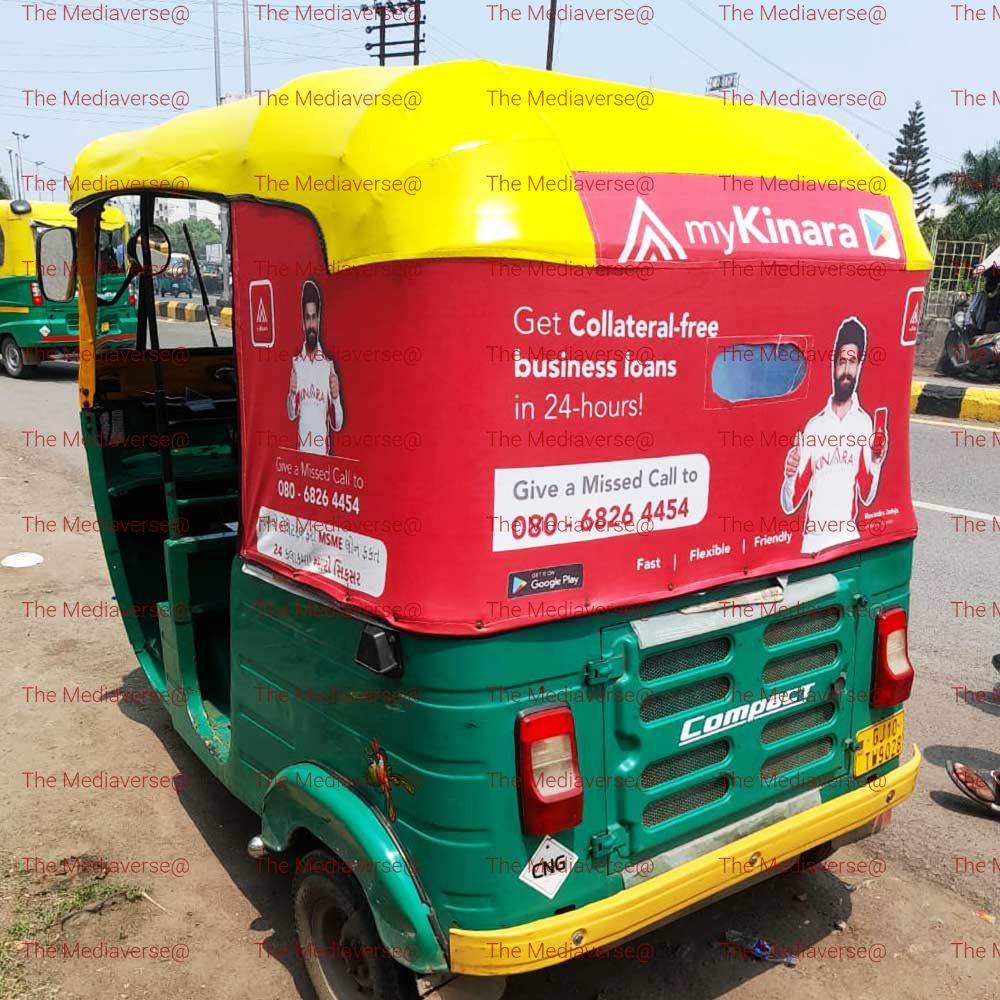
What is auto branding in Delhi and why does it work?
Auto branding in Delhi is hyperlocal outdoor advertising on auto-rickshaws. hood wraps and back-panel stickers. deployed across the capital's metro station exit zones and residential colony interiors. With 3+ lakh registered autos serving as the primary feeder transport from Delhi Metro's 250+ stations into colony interiors, Delhi auto rickshaw advertising captures commuters at the metro-to-home transition point. Each branded auto generates an estimated 18,000–35,000 daily impressions at ₹3–7 CPM, making it a high-frequency, low-cost format among Delhi-NCR outdoor media.
How much does auto branding cost in Delhi?
- • Full Hood Branding (Rexine Wrap): ₹650 per auto for 300–499 autos, ₹630 per auto for 500+ autos (one-time, MOQ 300)
- • Back Panel Sticker (Vinyl), 24"x6": ₹170 per auto for 500–799 autos, ₹140 per auto for 800+ autos (one-time, MOQ 500)
- • Back Panel Sticker (Vinyl), 24"x18": ₹270 per auto for 500–799 autos, ₹240 per auto for 800+ autos (one-time, MOQ 500)
All auto branding rates are one-time per auto (print plus install), not monthly. GST 18% extra. Some areas charge an auto-union fee, billed extra. NCR-wide deployment available: Delhi + Noida + Gurugram auto fleet at volume pricing. All rates include design, printing, installation, and GNCTD permits. Per The Mediaverse 2026 rate card.
Is auto branding effective in Delhi-NCR?
Yes. Auto branding in Delhi offers strong cost-per-impression efficiency as a high-frequency, low-cost outdoor format. Delhi's expanding metro system (250+ stations, 50+ lakh daily riders) creates the largest metro-exit-to-auto transition market in India. Branded autos stationed at metro exits like Rajiv Chowk, Kashmere Gate, and Dwarka capture commuters at their most attentive moment. when they emerge from underground and scan for last-mile transport into their residential colony.
Which Delhi areas are best for auto branding?
What results does auto branding deliver in Delhi?
Delhi auto branding is a high-frequency, low-cost format with strong cost-per-impression efficiency. Delhi's unique advantage: metro-exit auto clustering captures 50+ lakh daily metro riders at the station-to-colony transition. The format suits coaching centres near Mukherjee Nagar, healthcare brands near metro exits, and D2C apps using interior QR codes for last-mile conversion.
Can I run auto branding across Delhi, Noida, and Gurugram simultaneously?
Yes. The Mediaverse operates NCR-wide auto branding coordination across Delhi, Noida, Gurugram, Faridabad, and Ghaziabad. A single campaign can deploy branded autos across all NCR cities with unified creative, consolidated reporting, and volume pricing. This is unique to our NCR fleet. other agencies require separate coordination per city.
Delhi Auto Branding: Auto Rickshaw Advertising Built Around Metro Exits and Colony Interiors Across NCR
The Mediaverse captures 50 lakh daily Delhi Metro riders at the station-to-colony transition. the only advertising moment between underground and home.
Hood ₹650/auto one-time | Back Panel ₹170/auto one-time | NCR-wide coordination | GNCTD-compliant
Auto branding in Delhi operates on a structural advantage that no other Indian capital offers: the Delhi Metro system. With 250+ stations carrying 50+ lakh daily riders, Delhi has India's largest metro-to-auto transition market. Every metro rider who exits at Rajiv Chowk, Kashmere Gate, Dwarka Sector 21, or Rohini. and there are lakhs every hour. immediately transitions to an auto-rickshaw for the last 1–3 km into their residential colony. This station-exit-to-colony journey is the only outdoor advertising window between the metro platform and the commuter's front door.
The Mediaverse provides auto rickshaw advertising in Delhi through a metro-exit-colony clustering strategy. We deploy branded autos at specific metro station exits. concentrating 30–60 vehicles per station zone. then track as these autos penetrate the exact residential colonies that metro riders travel to. This creates a two-layer exposure: brand contact at the metro exit (high-attention transition moment) PLUS brand contact inside the colony (residential environment reinforcement). For arterial road visibility to complement colony-level reach, businesses can layer in mobile van branding in Delhi on Ring Road and NH-8 corridors.
The Mediaverse: Delhi-NCR's Only Auto Branding Agency with Metro-Exit-to-Colony Tracking
Other agencies scatter branded autos across Delhi randomly. The Mediaverse deploys them at specific metro station exits. Rajiv Chowk, Kashmere Gate, Dwarka Sector 21, Rohini West. then tracks as these autos penetrate the exact residential colonies that commuters travel to. This metro-exit-colony approach delivers two-layer brand exposure: contact at the station exit (high attention) plus contact inside the colony (environmental reinforcement). This two-layer approach is what makes auto branding a high-frequency, low-cost format. and we're the only Delhi agency measuring both metro-exit and colony-level conversion attribution.
What is Auto Branding in Delhi?
Auto branding in Delhi is hyperlocal outdoor advertising on auto-rickshaws. hood wraps (rexine) and back-panel stickers (vinyl). deployed across the capital's residential colonies, metro station exits, and market zones. Delhi has 3+ lakh registered auto-rickshaws operating under GNCTD regulations, serving as the primary feeder transport from Delhi Metro's 250+ stations into colony interiors where buses and cars struggle to navigate narrow lanes.
Why Delhi's metro system creates India's best metro-to-auto advertising opportunity
Delhi Metro carries approximately 50+ lakh daily riders. the highest metro ridership in India. At every station exit, commuters transition to auto-rickshaws or e-rickshaws for the final 1–3 km into their residential colony. This metro-exit transition is advertising gold: the commuter has emerged from underground, is at street level, and is actively scanning for their ride. A branded auto at the exit is the first visual stimulus post-metro. Auto rickshaw advertising in Delhi exploits this metro-to-colony feeder pattern in a way that no other OOH format. including Delhi mobile van branding on Ring Road. can replicate.
Delhi auto branding: formats, reach, and NCR coordination
Each Delhi auto generates an estimated 18,000–35,000 daily impressions at ₹3–7 CPM, based on The Mediaverse fleet tracking data. The Mediaverse is the only agency offering NCR-wide auto branding coordination. a single campaign deploying branded autos across Delhi, Noida, and Gurugram with unified creative, consolidated reporting, and volume pricing. For doorstep reach in the same colonies, businesses can add newspaper insertion in Delhi via Hindustan Times and Dainik Jagran. Physical storefront visibility can be established with shop name boards in Delhi.
Key facts about Delhi auto branding at a glance:
- • Fleet size: 3+ lakh GNCTD-registered autos across Delhi + NCR extension
- • Metro opportunity: 250+ stations, 50+ lakh daily riders transitioning to auto last-mile
- • Daily impressions/auto: 18,000–35,000 (tracked estimate)
- • CPM: ₹3–₹7. among the cheapest OOH in Delhi-NCR
- • NCR coordination: Delhi + Noida + Gurugram in a single campaign
- • Colony penetration: Enters Dwarka sectors, Rohini sectors, Vasant Kunj lanes
Auto Branding in Delhi. Quick Facts
Why Delhi's Metro Network Creates India's Largest Metro-Exit Auto Advertising Opportunity
Delhi Metro is India's largest metro system. 250+ stations, 6 colour-coded lines, 50+ lakh daily riders. At every single exit, commuters transition to auto-rickshaws. No other Indian city has this scale of metro-to-auto transition volume.
Metro-Exit Capture (250+ Stations)
Delhi Metro's 250+ stations create 250+ potential auto branding deployment points. At each exit, commuters emerge from underground in a heightened-attention state. scanning for their last-mile ride. A branded auto at Rajiv Chowk or Kashmere Gate exit is the first brand a commuter encounters after 30+ minutes underground. In our experience, metro-exit positioned autos tend to achieve stronger recall than randomly placed autos in Delhi.
Key lines: Yellow (Samaypur Badli–HUDA), Blue (Dwarka–Noida), Violet (Kashmere Gate–Ballabhgarh)
Colony-Interior Penetration
Delhi's residential geography is built on colony sectors. Dwarka Sectors 1–23, Rohini Sectors 1–24, Vasant Kunj pockets, and hundreds of DDA colonies. Auto-rickshaws are the only motorized transport that navigates colony internal roads. narrow lanes, dead-ends, and park-circling routes where buses and cars cannot operate efficiently. A branded auto inside Dwarka Sector 12 is the only outdoor ad a resident encounters between their door and the sector's main road.
Colony zones: Dwarka (23 sectors), Rohini (24 sectors), Vasant Kunj, Saket, Pitampura
NCR Cross-City Reach
Delhi Metro extends into Noida (Blue Line) and Gurugram (Yellow/Rapid Metro). Commuters who board at Rajiv Chowk and exit at Noida Sector 62 transition to Noida autos for the final mile. A single NCR auto branding campaign can deploy branded vehicles across Delhi colony exits + Noida sector exits + Gurugram sector exits. reaching the entire 4.6 crore NCR population through one coordinated campaign.
NCR extension: Noida Sectors 15–62, Greater Noida, Gurugram Sectors, Faridabad
5 Highest-Value Metro-Exit Auto Zones in Delhi-NCR
Rajiv Chowk (Yellow+Blue)
India's busiest metro station. Exits serve CP, Janpath, and Barakhamba. Delhi's premium commercial audience. Auto branding here captures corporate professionals, government officials, and tourist visitors.
Kashmere Gate (Red+Yellow+Violet)
Delhi's largest metro interchange (3 lines converge). Adjacent to ISBT. inter-state travellers. Massive auto fleet serves Old Delhi colonies, Civil Lines, and North Campus student areas.
Dwarka Sector 21 (Blue+Airport)
Gateway to Dwarka's 23 residential sectors. Auto fleet ferries commuters from metro to colony interiors. Family-dominant demographic. strong for healthcare, education, and local retail auto branding.
Rohini West (Red Line)
Serves Rohini's 24 residential sectors. one of Delhi's largest planned residential areas. Auto branding in Rohini sectors achieves high household-level frequency due to concentrated colony geography.
Lajpat Nagar (Violet Line)
South Delhi's shopping hub. Auto fleet connects metro riders to Lajpat Nagar market, Defence Colony, and GK residential zones. Retail and fashion brands see highest walk-in conversion from this zone.
3 Colony Zones Where Auto Branding in Delhi Creates Sector-Level Saturation
Dwarka. 23 Residential Sectors
Approximately 12 lakh residents across 23 sectors connected by the Blue Line metro. Each sector has its own auto stand serving the metro-exit-to-home route. A 50-auto branded cluster across Sectors 10–15 generates repeated weekly brand encounters per household. The sector-grid layout makes Dwarka ideal for auto branding in Delhi because autos circulate within defined geographic boundaries.
Rohini. 24 Residential Sectors
Approximately 10 lakh residents across 24 sectors served by the Red Line metro. Over 400 autos operate within Rohini's sector network. Auto rickshaw advertising in Rohini sectors reaches a predominantly middle-class family audience. the core demographic for coaching centres, hospitals, and FMCG brands. Back-panel campaigns at ₹170/auto (one-time) achieve the lowest cost-per-household-encounter of any Delhi advertising format.
South Delhi Colonies. GK, Saket, Vasant Kunj
Approximately 8 lakh residents in Delhi's highest-income residential belt. Auto fleet connects Violet Line metro exits (Lajpat Nagar, Saket, Hauz Khas) to colony interiors. Auto branding in South Delhi colonies reaches the capital's premium consumer segment. effective for luxury retail, premium healthcare, and financial services. Hood branding on the South Delhi fleet commands the highest per-impression value in our Delhi portfolio.
Material Specifications: How Our Auto Branding Survives Delhi's Extreme Climate
Delhi experiences the widest temperature range of any Indian metro. 48°C summer peaks and near-zero winter mornings. plus dense winter fog and monsoon rains. Standard materials fail within 60 days. The Mediaverse uses Delhi-specific upgraded specifications:
Hood: UV-Resistant Rexine
100-micron rexine rated for 48°C Delhi summers. UV-stabilized lamination prevents colour degradation. Heat-resistant adhesive maintains bond through extreme summer temperature cycles.
Back Panel: Dust-Proof Vinyl
Sealed-edge vinyl with anti-dust coating for Delhi's particulate-heavy air. Reflective ink treatment for visibility during December-January fog season. Rain-proof lamination for monsoon months.
All-Season Guarantee
Free replacement within 48 hours for any weather-damaged unit. Monthly field audits across the branded fleet. Materials rated for 12+ months across Delhi's full summer-monsoon-winter-fog cycle.
Delhi Advertising Market Overview
Delhi NCR, with a combined population exceeding 3 crore, is India's largest advertising market. The city's grid-like road network — featuring Ring Road, Outer Ring Road, and arterial roads connecting to Gurgaon, Noida, and Ghaziabad — provides excellent coverage for mobile van campaigns. Delhi's advertising peaks during Diwali, Republic Day, election seasons, and the wedding season (November-February). Key industries driving demand include real estate (Gurugram and Noida projects), education (entrance exam season), FMCG brands, and political campaigns. Delhi's strict billboard regulations make mobile vans a regulatory-compliant alternative with higher reach. The city's metro connectivity means arterial roads carry concentrated vehicular traffic, amplifying van advertising impressions.
Auto Branding Formats Available in Delhi-NCR
Full Hood Branding (Rexine Wrap)
Complete rear hood coverage with 100-micron UV-resistant rexine. Colour-matched to Delhi's green-yellow auto standard. Visible from behind, above, and both sides. The premium format for metro-exit station zones and colony-interior brand dominance.
- ✓100-micron UV-resistant rexine (48°C Delhi rated)
- ✓Green-yellow auto colour-matched for Delhi fleet
- ✓Fog-season reflective treatment for Dec-Jan visibility
- ✓Includes design, print, installation, GNCTD permits
Back Panel Sticker (Vinyl), 24"x6"
Dust-proof vinyl sticker on the auto's rear panel with sealed-edge lamination. Eye-level with trailing traffic in colonies and at metro exits. The lowest-cost format for NCR-wide mass deployment campaigns requiring 500+ autos across Delhi, Noida, and Gurugram.
- ✓Dust-proof sealed vinyl for Delhi's air quality
- ✓Eye-level with colony traffic and metro-exit pedestrians
- ✓NCR-wide deployment: Delhi + Noida + Gurugram
- ✓Volume pricing for 800+ auto campaigns
Back Panel Sticker (Vinyl), 24"x18"
Larger-format dust-proof vinyl sticker on the auto's rear panel with sealed-edge lamination. Bigger visual footprint at eye-level with trailing traffic in colonies and at metro exits. Ideal for brands needing more creative space across a 500+ auto deployment.
- ✓Dust-proof sealed vinyl for Delhi's air quality
- ✓Larger 24"x18" footprint for more creative space
- ✓NCR-wide deployment: Delhi + Noida + Gurugram
- ✓Includes design, print, installation, GNCTD permits
Auto Branding vs Newspaper Flyers vs Local Billboards in Delhi
| Parameter | Delhi Auto Branding | Newspaper Flyers | Local Billboards |
|---|---|---|---|
| CPM | ₹3–7 | ₹12–25 | ₹35–70 |
| Metro-exit coverage | Yes. autos at 250+ station exits | No | Rare. limited near stations |
| Colony-interior reach | Yes. enters sector internal roads | Door delivery (often discarded) | No. main road only |
| NCR cross-city | Delhi + Noida + Gurugram unified | Separate per city | Fixed location per city |
| Daily impressions/unit | 18,000–35,000 per auto | 1,000–3,000 per batch | 5,000–15,000 per board |
| Odd-even resilient | Yes. autos exempt from odd-even | N/A | N/A |
| Cost efficiency | Highest (lowest CPM) | Moderate | Lowest (highest CPM) |
| Setup speed | 48 hours | 3–5 days | 10–21 days |
Indicative comparison based on typical Delhi-NCR outdoor media rates.
The Delhi Metro-Exit Colony Grid. Our Auto Deployment Methodology
We deploy auto branding at specific metro station exits and track as autos penetrate the exact residential colonies that commuters travel to. creating two-layer exposure: metro-exit contact + colony-interior reinforcement.
Metro Line Mapping
Identify which metro line serves your target colony (e.g., Blue Line for Dwarka, Red Line for Rohini). Map auto stands at target station exits and within colony sectors.
Exit-Colony Clustering
Deploy 30–60 branded autos from stands at the station exit AND within the colony interior. These autos naturally shuttle commuters between metro and home. delivering brand contact at both ends.
NCR Coordination
For brands targeting multiple NCR cities: unified creative across Delhi, Noida, and Gurugram auto fleets. Single reporting dashboard. Volume pricing applied across all cities.
Two-Layer Tracking
Weekly reports showing metro-exit zone coverage + colony-interior penetration estimates. Monthly field audits. Integration with dedicated phone lines and QR tracking for conversion attribution.
Best Areas for Auto Branding in Delhi
These are the top-performing localities for mobile van advertising in Delhi, selected based on footfall density, commercial activity, and campaign ROI data from The Mediaverse.
Connaught Place
Central Delhi commercial hub with premium retail and office traffic
Karol Bagh
One of Delhi's busiest shopping districts with heavy footfall
Lajpat Nagar
Popular market area attracting diverse demographics
Chandni Chowk
Old Delhi commercial heart with wholesale and retail activity
Saket
South Delhi shopping hub with Select Citywalk and DLF Place
Rajouri Garden
West Delhi commercial zone with high retail density
Dwarka
Residential township with young families and growing commerce
Rohini
North Delhi's largest residential zone with 20+ lakh residents
Noida (NCR)
IT and corporate hub in Sector 62, 18, and Film City area
Gurgaon (NCR)
Cyber City, Golf Course Road — premium corporate audience
Nehru Place
IT hardware market with tech-focused footfall
Pitampura
North Delhi educational and residential zone
Janakpuri
West Delhi residential area with District Centre commerce
INA Market
Central Delhi market near diplomatic enclave
Greater Kailash
Affluent South Delhi market with high-spending consumers
Which Businesses Benefit Most from Auto Branding in Delhi-NCR?
Coaching & Competitive Exam Prep
Delhi's biggest auto branding category. Coaching centres near Mukherjee Nagar (UPSC), Rajinder Nagar (UPSC/SSC), and Kalu Sarai (GATE) deploy station-exit auto clusters targeting students commuting via metro. The metro-exit format typically delivers enrollment inquiries at a lower cost than Google Ads for competitive Delhi coaching keywords.
Healthcare & Hospitals
Hospitals near metro stations use exit-zone auto branding to capture commuters as potential patients. The metro-exit attention moment is particularly effective for healthcare messaging. commuters in transition are more receptive to "nearby hospital" brand signals. Auto branding in Delhi colony interiors reinforces the message during the ride home.
Government Scheme Awareness
Delhi's status as the national capital means government scheme awareness campaigns (Jan Dhan, Ayushman Bharat, Skill India) deploy auto fleets across DDA colonies and JJ clusters. reaching citizens who may not have digital access. Back-panel campaigns at ₹170/auto (one-time) provide the lowest-cost citizen-reach format available.
D2C Apps & Fintech
Back-panel QR codes on metro-exit autos capture Delhi's tech-savvy metro-riding demographic during their 15–25 minute last-mile ride. Metro riders in "phone-ready" mode scan QR codes at higher rates than pedestrians encountering outdoor QR placements, making back-panel QR a cost-efficient install channel.
Real Estate (Dwarka/Rohini/NCR)
Developers deploy sector-specific auto fleets (e.g., Dwarka Sectors 10–15 autos for new Dwarka Expressway projects) to reach resident-buyers in the exact colony where they currently live. The familiarity of seeing a project name on "their" colony autos accelerates site-visit decisions.
Political Campaigns
Delhi's MCD ward-level political campaigns use auto branding as the primary hyperlocal reach medium. deploying branded autos in specific ward boundaries where door-to-door canvassing would take weeks. Auto branding provides ward-level saturation at ₹170/auto (one-time), making it the most cost-efficient political advertising format in the capital.
How Do We Plan Auto Branding Corridors Across Delhi-NCR?
Delhi is not one auto market. It is a set of distinct circuits, each with its own audience, its own stand culture and its own best format. This is how our field team actually carves up the map.
The North Delhi coaching belt: GTB Nagar to Mukherjee Nagar
Autos on this circuit shuttle between the Yellow Line exits at Vishwavidyalaya and GTB Nagar and the PG and hostel lanes of Mukherjee Nagar, Nehru Vihar and Outram Lines. The riders are UPSC and SSC aspirants who take the same short auto hop several times a week, so a back-panel creative here builds recognition quickly among a tightly defined audience. We time coaching campaigns to batch cycles: fresh enrolment interest builds after board results in May and again after the prelims calendar is announced, and stands here fill up with competing coaching creatives in those weeks, so booking early matters.
The trans-Yamuna value circuit: Laxmi Nagar, Preet Vihar, Mayur Vihar
East Delhi runs on autos and e-rickshaws in a way South Delhi does not, because colony lanes off Vikas Marg are too tight for much else. Laxmi Nagar carries a heavy CA and commerce coaching population plus dense middle-income housing, which suits high-volume 24"x6" back-panel deployments where the lower per-auto cost lets a brand saturate a full circuit. One practical note from the field: our branded formats are fitted on registered CNG autos, not on e-rickshaws, so counts quoted for this belt reflect the auto fleet only.
Market circuits: Karol Bagh, Lajpat Nagar and Sarojini Nagar
Shoppers leaving Lajpat Nagar Central Market or the Ajmal Khan Road stretch in Karol Bagh almost always leave by auto, hands full of bags, headed back to a nearby colony. Hood wraps work harder than back panels here because queued autos outside market gates are seen front-on by the crowd waiting for a ride. Wedding-season months, roughly November to February, lift both footfall and auto demand around these markets, which is when jewellers, apparel brands and banquet services get the most from the circuit.
The winter-smog note every Delhi advertiser should read
From late October through January, smog and fog cut long-range visibility across the capital. Hoardings that rely on being read from 100 metres away lose effectiveness on the worst air days; an auto back panel is read from a car length behind at a signal, so short-range formats hold their value through the season. Autos are also exempt from odd-even restrictions, and our fog-season units carry reflective ink treatment. Practically, this makes November to January a strong window for auto branding in Delhi rather than a dead one, provided the creative uses bold type and high contrast rather than fine detail.
Delhi-NCR Auto Branding Pricing (2026)
| Format | Standard Tier | Volume Tier | MOQ | Best For |
|---|---|---|---|---|
| Full Hood (Rexine) | ₹650 (300–499) | ₹630 (500+) | 300 | Metro-exit brand awareness |
| Back Panel 24"x6" (Vinyl) | ₹170 (500–799) | ₹140 (800+) | 500 | Mass colony-level reach |
| Back Panel 24"x18" (Vinyl) | ₹270 (500–799) | ₹240 (800+) | 500 | Larger-format colony reach |
All rates are one-time per auto (print plus install), not monthly. GST 18% extra. Some areas charge an auto-union fee, billed extra. Volume tiers apply to combined Delhi + Noida + Gurugram deployments. All rates include design, printing, installation, GNCTD permits, and field audits.
📍 Delhi Pricing Note: Connaught Place and South Delhi (GK, Saket, Hauz Khas) routes carry a 15–20% premium. NCR routes covering Gurgaon and Noida are at standard rates. Election season (state or national) may require additional permissions for branded vans.
Delhi-NCR Auto Branding Campaign Results
Results from The Mediaverse Delhi auto branding campaigns demonstrating the metro-exit-colony approach.
UPSC Coaching. Mukherjee Nagar
500 back-panel autos at Vishwavidyalaya metro exit + Mukherjee Nagar colony stands targeting UPSC aspirants commuting to coaching via metro.
- • Format: Back panel 24"x6" (₹170/auto, one-time)
- • Zone: Vishwavidyalaya exit + Mukherjee Nagar
- • Duration: 60 days | Investment: ₹85,000 (one-time, plus GST)
- • Goal: Coaching enrollment inquiries
Hospital. Dwarka Sector 12
300 hood-branded autos at Dwarka Sector 21 metro exit + Sectors 10–15 colony interior for 90-day health check-up awareness campaign.
- • Format: Full hood (₹650/auto, one-time)
- • Zone: Dwarka metro exit + Sectors 10–15
- • Duration: 90 days | Investment: ₹1,95,000 (one-time, plus GST)
- • Goal: Local walk-in awareness
Fintech App. NCR Campaign
800 back-panel autos with QR codes across Rajiv Chowk exit (Delhi), Noida Sector 18 exit, and Gurugram Cyber Hub exit. QR code targeting metro commuters during last-mile ride.
- • Format: Back panel 24"x6" + QR (₹140/auto, one-time)
- • Zone: Delhi + Noida + Gurugram metro exits
- • Duration: 45 days | Investment: ₹1,12,000 (one-time, plus GST)
- • Goal: Metro-rider app installs via QR
From The Mediaverse Team
Delhi-NCR Auto Branding
“Delhi's auto branding market has a structural advantage that gets stronger every year: the metro system keeps expanding. Each new metro station creates a new auto-exit-zone advertising opportunity. When the Blue Line extended to Greater Noida, it created 12 new station-exit zones overnight. Each zone has its own auto fleet, its own colony catchment, and its own commuter profile. No other Indian city generates new hyperlocal advertising inventory at this rate.
The metro-exit-colony approach works because it creates two contact moments in one commute. The commuter sees the branded auto at the station exit (high attention, scanning mode), then sees the same brand on autos inside their colony (familiar, environmental mode). Two different psychological contexts, one campaign, one cost. In our experience, this two-layer approach tends to drive stronger recall than station-exit-only or colony-only placements.
For brands entering Delhi auto rickshaw advertising, start with 500 back-panel autos (24"x6") across 2 metro-exit zones: approximately ₹85,000 one-time (plus GST). Choose stations based on your colony catchment (Dwarka for West Delhi families, Rohini for North Delhi middle class, Lajpat Nagar for South Delhi premium). Measure walk-ins or QR scans per zone, then scale to full sector coverage or NCR-wide deployment.”
Why Choose The Mediaverse for Auto Branding in Delhi-NCR
Metro-Exit Colony Tracking
Autos are placed at named station exits, Rajiv Chowk, Kashmere Gate, Dwarka Sector 21, and then followed into the sectors those exits feed. You see both layers in the report: exit-zone contact and colony-interior reinforcement.
NCR-Wide Coordination
One desk books Delhi, Noida and Gurugram stands together, applies volume slabs to the combined count, and sends you a single consolidated report. No juggling three city vendors for one region.
All-Season Materials
The spec follows Delhi's calendar: UV-resistant rexine for June heat, reflective treatment for the January fog weeks, dust-proof sealed vinyl for the capital's air, and rain-proof lamination before the monsoon arrives.
Auto Branding in Delhi: Frequently Asked Questions
Q: How much does auto branding cost in Delhi?
Think of it as a one-time print-and-fit charge per auto, never a monthly rental. Back panels in dust-proof vinyl are the entry point: the 24"x6" size runs ₹170 per auto for 500–799 vehicles and ₹140 once you cross 800, while the larger 24"x18" size is ₹270 and ₹240 on the same slabs, both with a 500-auto minimum. The full hood wrap in UV-resistant rexine, the format we favour for metro-exit zones like Dwarka Sector 21 or Rohini West, costs ₹650 per auto for 300–499 autos and ₹630 from 500 up, minimum 300. Design, printing, fitting, GNCTD permits and field audits are built into these rates. GST at 18% applies on top, and a few stand areas levy an auto-union fee that is billed separately.
Q: How many autos are available for branding in Delhi-NCR?
GNCTD records put Delhi's registered auto fleet above 3 lakh, and once you add the stands in Noida, Gurugram, Faridabad and Ghaziabad the NCR pool crosses 5 lakh vehicles. Our stand relationships stretch from the Kashmere Gate and Rajiv Chowk exits down to sector stands inside Rohini and Dwarka, which is why a first batch of 100 branded autos can be on the road within 48 hours of artwork approval. A 500-plus NCR rollout, say Delhi colonies plus Noida Sector 18 plus Gurugram sector stands, typically wraps in 5–7 days.
Q: Which Delhi metro stations are best for auto branding?
Match the station to your catchment rather than chasing raw footfall. Rajiv Chowk moves roughly 4 lakh exits a day and skews corporate and government. Kashmere Gate, where three lines and the ISBT converge, adds Old Delhi, Civil Lines and North Campus students at around 3 lakh exits. Dwarka Sector 21 (about 2 lakh exits) is the gateway into 23 family-heavy sectors, Rohini West (roughly 1.5 lakh) feeds 24 middle-class sectors, and Lajpat Nagar (around 1.2 lakh) mixes market shoppers with South Delhi residents. A coaching brand belongs near Vishwavidyalaya and Kashmere Gate; a hospital belongs at Dwarka and Rohini.
Q: Can auto branding run across Delhi, Noida, and Gurugram simultaneously?
It can, and this is where the NCR fleet earns its keep. One creative, one reporting dashboard and one account manager cover all three cities together, with volume pricing applied to the combined auto count rather than city by city. A brand can hold Dwarka and Rohini colony stands, Noida Sector 18 and the Gurugram sector stands under a single campaign instead of juggling three local vendors, which is how the region is usually handled elsewhere.
Q: What results can I expect from auto branding in Delhi?
Treat it as a frequency medium first. At ₹3–7 CPM it is among the cheapest OOH buys in Delhi-NCR, and the same households keep meeting the same branded autos on the school run, the market trip and the metro ride home. UPSC coaching centres around Mukherjee Nagar, hospitals running Dwarka sector drives and fintech apps using back-panel QR codes have all used it as their base layer. Outcomes swing with format, station zone, colony demographic and creative, so track QR scans or walk-ins zone by zone before you scale.
Q: Are Delhi autos exempt from odd-even restrictions?
They are. Auto-rickshaws sit outside Delhi's odd-even pollution control scheme, so a branded auto fleet keeps circulating right through the winter restriction windows while car-mounted media and some van campaigns lose road days. For brands that need continuity through the smog season, that exemption is a genuine scheduling advantage.
Q: Are materials designed for Delhi's extreme climate?
They have to be, because Delhi swings from 48°C in June to near-zero fog mornings in January, with a dusty monsoon and particulate-heavy air in between. Hoods use 100-micron UV-resistant rexine, back panels use sealed-edge dust-proof vinyl, the December-January fog weeks get reflective ink treatment, and rain-proof lamination covers the monsoon. The spec is rated for 12 plus months across the full annual cycle, and any weather-damaged unit is replaced free within 48 hours.
Q: Why choose The Mediaverse for auto branding in Delhi-NCR?
Because we run the format the way a Delhi operator has to. Deployment is planned around specific metro exits and then tracked into the colonies those exits feed, so one budget buys two exposure layers. Delhi, Noida and Gurugram sit on a single coordination desk with unified reporting instead of three vendor relationships. And materials are specced for the capital's own climate, from 48°C summers through December fog to the monsoon, rather than borrowed from a coastal city's rate card.
Build a Complete Delhi-NCR Advertising Strategy
Auto branding in Delhi delivers metro-exit-to-colony coverage. For Ring Road arterial visibility, add van branding. For doorstep reach in the same colonies, add newspaper insertion. For physical storefront presence, install shop boards.
Mobile Van Branding in Delhi
For arterial Ring Road and NH-8 visibility. where auto branding doesn't reach. Vans handle highways, autos handle metro exits and colonies.
Explore Delhi Van Branding →Shop Name Boards in Delhi
Establish physical storefront presence with ACP and LED signage across Karol Bagh, Chandni Chowk, Lajpat Nagar, and all Delhi commercial zones.
Explore Delhi Shop Boards →Newspaper Insertion in Delhi
Reach the same colony households at the doorstep via pamphlet insertion in Hindustan Times, Dainik Jagran, and Navbharat Times.
Explore Delhi Newspaper Ads →Auto Branding in Other Cities
The Mediaverse offers auto branding across India. Explore our services in these cities:
Also Available in Nearby Cities
Put Your Brand on Delhi's Autos, From the Metro Exit to the Colony Gate
Two windows book out fastest in Delhi: the Diwali run-up in October-November and the June-August admission season. For deployments of 200-plus autos across NCR, give us 7 days of lead time.
Tell us your target stations and colonies, and the NCR coordination desk will send a zone-wise quote the same day.
Explore More Advertising Services
Auto Branding services across India
All Services in DelhiAuto, van, print and signage advertising in Delhi
Mobile Van Branding in DelhiView mobile van branding options in Delhi
Newspaper Insertion in DelhiView newspaper insertion options in Delhi
Shop Name Board in DelhiView shop name board options in Delhi
No Parking Board Advertising in DelhiView no parking board advertising options in Delhi
Auto Branding in Other Cities
Auto Branding in Other Cities
The Mediaverse offers auto branding across India's top markets.
More Advertising Services in Delhi
Explore all outdoor advertising options available in Delhi, Delhi.